Adult Websites List and Category
Adult content domain classification for vendors, built for CIPA filtering, parental controls and workplace safety policies. Explicit websites are kept separate from swimwear and sex education.
We run the web filter for your library or school
Set one DNS address on your router and every device is filtered: CIPA categories blocked, a staff PIN for adult research, and reports for your records. Nothing to install.
How Adult Content Domains Are Detected
Every domain in the Adult category is categorized from its site content, then reviewed and validated. The aim is to block explicit websites reliably while leaving medical, educational, art and news sites open.
- The label is based on what a site shows, not only on words in its domain name.
- That matters because many adult sites use generic or meaningless domain names.
- Sites can carry several categories, ranked by how much of the site each one describes, so mixed platforms are not treated like explicit ones.
- About 300,000 newly registered domains are categorized every day and checked again after a week and after a month.
- All other domains are refreshed monthly, so parked or re-registered domains that turn explicit are picked up.
- Regular manual validations measure accuracy, and licence holders receive validation reports for the CIPA categories.
Turn the Adult switch on once and every device behind the router follows
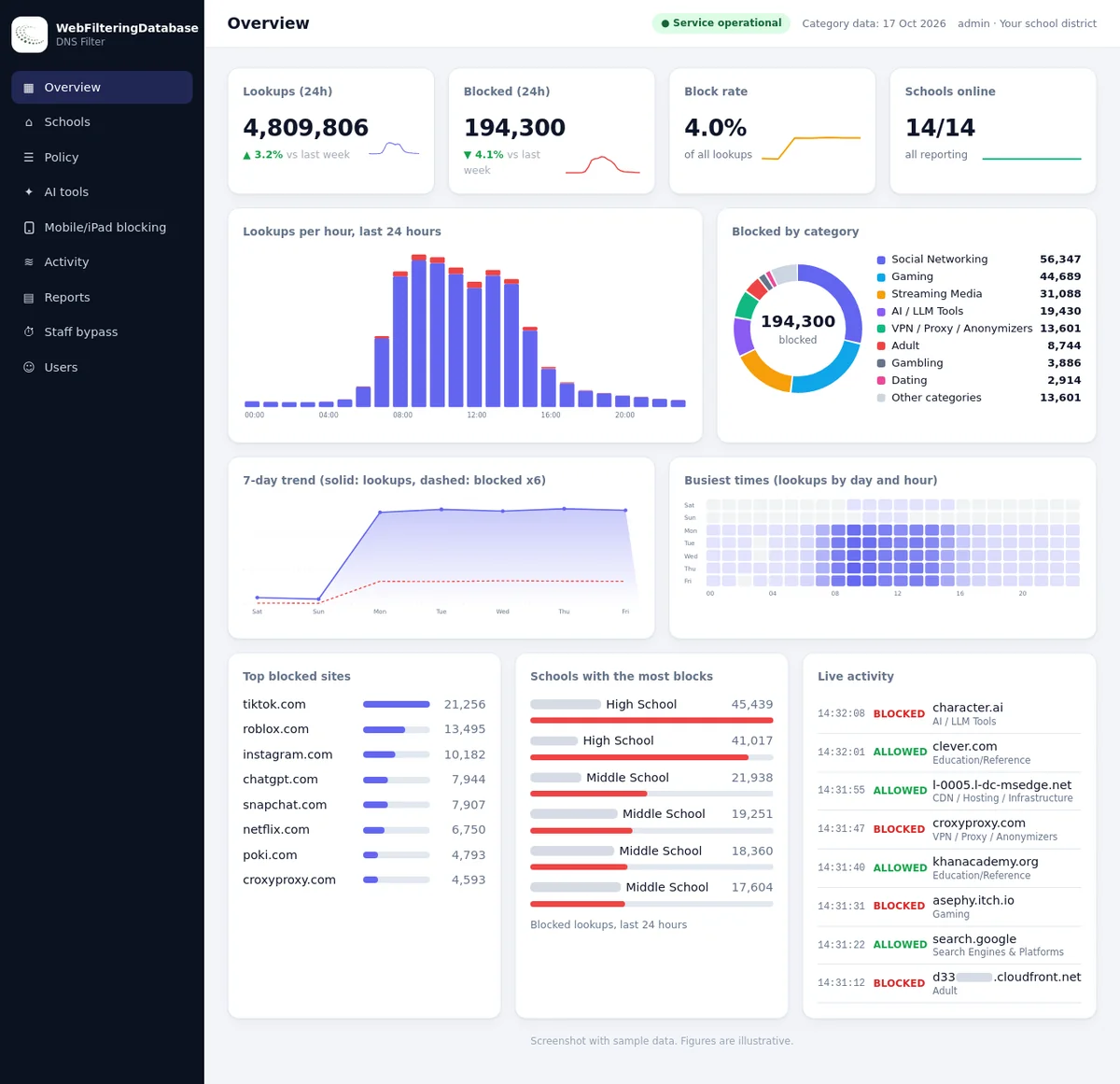
A list of explicit domains is only useful if something enforces it. Our managed DNS filter reads the same Adult category described on this page and applies it to a whole network from one DNS address.
- Keep Adult blocked on student and guest networks and decide separately for staff offices.
- Add a single allowed address to the always-allow list instead of weakening the category.
- Searchable activity shows which devices ran into the block.
How the Adult Category Is Delivered and Kept Current
What a licence holder receives for the adult category, and how it stays up to date
Content-Based Labels
Domains are categorized from site content, reviewed and validated, rather than from keyword lists.
- Medical, educational and news domains that use similar words keep their own categories.
Separate Neighbour Categories
Explicit content, suggestive fashion and sex education sit in three different categories.
- Policies can block Adult everywhere and decide on Lingerie/Swimsuits and Health & Medicine by audience, for example by age group.
Ranked Categories
A domain can carry several categories, ranked by how much of the site they describe.
- A large platform with a small explicit section keeps its main category first.
- Strict policies can block Adult at any rank; lighter ones only when it ranks first.
Daily New Domains
About 300,000 newly registered domains are categorized every day.
- Results ship as daily delta files, so new explicit websites reach your filter quickly.
- Each new domain is checked again after a week and after a month.
Files That Run on Your Systems
The database is delivered as CSV, Parquet or JSON and runs inside your own systems, on-premise or air-gapped.
- Licensed customers can also take hosts files, DNS RPZ, AdGuard or Pi-hole style lists, firewall EDLs and PAC files.
- A lookup API is included with every licence.
Continuous Re-classification
All domains outside the new-domain checks are refreshed monthly.
- A domain that once hosted ordinary content may turn explicit, or an expired domain may be registered again for adult content.
- The monthly refresh keeps the category in line with what sites show today.
Compliance & Use Cases
Adult content filtering is required across education, workplace, and family environments
CIPA Compliance
The Children's Internet Protection Act (CIPA) requires schools and libraries receiving E-Rate funding to block visual depictions that are obscene, contain child pornography, or are harmful to minors. Our adult content classification provides the foundation for CIPA web filtering.
- Covers the core of the CIPA technology protection measure
- Appropriate for E-Rate and LSTA funding compliance
- Supports authorized staff override capability
- Validation reports with measured accuracy of the CIPA categories
- Differentiated policies for minors and adults
Parental Controls
Parents deploying home network filtering rely on accurate adult content classification to protect children from age-inappropriate material. Our database integrates with popular router firmware, DNS filtering services, and parental control applications.
- Covers all device types and browsers automatically
- DNS-level blocking requires no per-device software
- Separate categories for explicit, suggestive and health content
- Health and education sites stay out of the Adult category
- Explicit dating covered; mainstream dating has its own category
Workplace Filtering
Employers have both legal obligations and practical reasons to filter adult content: accessing adult material on work devices creates hostile work environment liability, consumes bandwidth, and poses security risks as adult sites are frequent vectors for malware distribution.
- Reduces hostile work environment liability exposure
- Prevents bandwidth consumption by streaming adult content
- Blocks a common malware distribution vector
- HR policy enforcement through technical controls
- Comprehensive logging for incident investigation
Public WiFi Networks
Hotels, restaurants, airports, and other venues offering public WiFi commonly filter adult content to maintain a family-friendly environment and reduce liability. Our API enables transparent filtering across all devices connecting to the network without user-side software installation.
- Transparent filtering without captive portal software
- Protects venue reputation and brand image
- Reduces legal liability for content accessed on premises
- Works across all devices and operating systems
- No impact on legitimate browsing performance
Adult Content Category Statistics
Coverage facts for the database behind the adult category
Minimizing False Positives
Good adult content filtering means more than blocking explicit material. Medical websites about anatomy, health education resources, art galleries and news sites covering sensitive topics must stay accessible.
Contextual Understanding
The category separates adult content from legitimate uses of similar words or images. Medical, educational, news and art sites keep their own categories because of their editorial purpose.
Policy Choices by Audience
Ranked categories let each policy pick its own strictness. K-12 policies often block Adult at any rank, workplaces when it ranks first, and higher education or research networks may allow more.
Integration Guide for Adult Content Filtering
Deploy adult content blocking across DNS, web proxy, and application layers
DNS-Based Filtering
The simplest deployment model. Load the adult category into your recursive DNS servers as an RPZ zone, or check domains with the lookup API, and every device on the network is covered without client software. This catches requests from all applications, not just web browsers.
Web Proxy Integration
Proxies and secure web gateways can match the full host name against the database. Explicit content on a subdomain of a shared platform can then be handled separately from the parent domain.
Real-Time API
Developers of parental control tools, browser extensions and content-aware apps can ship a local copy of the database for fast, private lookups. The lookup API included with a licence covers anything not yet in that copy.
- Daily delta files for newly categorized domains
- Hosts file, AdGuard and Pi-hole style exports
- Lookup API included with every licence
- CSV, Parquet and JSON files that run on-premise
Domain Lookup API
- Look up any domain or URL and get its ranked categories
- Explicit sites return Adult; swimwear and sex education return their own categories
- Use it for domains not yet in your local copy of the database
- Included with every licence
School DNS Filter Setup
- Load the Adult category as a DNS RPZ zone on the district resolvers
- Add the other categories your internet safety policy blocks
- Apply the daily delta file so new explicit domains are covered
- Keep the validation reports with your CIPA documentation
Adult vs Lingerie/Swimsuits vs Health: Where the Line Sits
Three categories touch on the body and sexuality. Keeping them apart is what lets a school block explicit websites without also blocking a swimwear shop or a sexual health clinic.
Adult
Sites whose main purpose is sexually explicit material. This is the category every CIPA and family policy blocks.
- Pornographic video and image sites
- Live cam and explicit chat services
- Explicit stories, comics and animation
- Escort listings and explicit adult dating
- Link lists and directories of explicit sites
- Fashion retailers, art museums, medical sites
Lingerie/Swimsuits/Intimate Apparel
Suggestive but not explicit. Many workplaces allow it, many schools block it, so it needs its own label.
- Lingerie and swimwear brands and shops
- Swimsuit and glamour photo galleries without nudity
- Intimate apparel catalogues
- General clothing stores, which stay in Shopping
- Anything with explicit content, which is Adult
Health & Medicine
Sex education and sexual health belong here. Schools then choose by age group instead of losing the content entirely.
- Sex education and puberty resources
- Sexual and reproductive health clinics
- Anatomy references and medical encyclopedias
- Explicit material presented as "education"
Where well-known adult and borderline sites land
Explicit sites carry Adult, while lingerie retail and general community platforms stay in their own categories. The rows below are records from our database.
| Domain | Label in our data | Blocked by the Adult switch? |
|---|---|---|
| pornhub.com | Adult | Yes |
| xvideos.com | Adult | Yes |
| onlyfans.com | Adult | Yes |
| playboy.com | Lingerie/Swimsuits/Intimate Apparel | No, that category has its own switch |
| reddit.com | Social Networking, Forums / Message Boards, Community Sites | No |
What CIPA Asks of Schools and Libraries
The Children's Internet Protection Act applies to schools and libraries that receive E-Rate discounts or certain library funding. Here is what it requires, stated simply. Check the current FCC guidance for the details.
A technology protection measure
A filter that blocks or filters visual depictions that are obscene, child pornography, or harmful to minors, on computers used by minors. The Adult category is the core of this.
Adults are covered too
The obscene and child pornography parts apply to adult users as well. An authorised person may disable the filter for an adult doing bona fide research or other lawful work.
An internet safety policy
A written policy that covers minors' access to inappropriate material, safety in email and chat, hacking, and disclosure of minors' personal information.
Public notice and a meeting
The policy must be discussed at at least one public meeting or hearing after reasonable public notice.
Monitoring and education in schools
Schools must monitor minors' online activities and educate them about appropriate online behaviour, including social networking and cyberbullying.
Certification
Compliance is certified on FCC Form 486 by schools and libraries, or Form 479 by consortium members.
Research access that closes by itself
A teacher, librarian or compliance officer can enter a staff PIN to open the Adult category for 15, 30 or 60 minutes. The block returns on its own and every use is written to the activity log.
How New Adult Domains Appear Every Day
Explicit websites are registered in large numbers, often in batches with similar names, and many stay empty for a while. A static adult domain list falls behind fast. This is how a new domain moves through the database.
Registration
The domain is registered. It may show a parked page, a "coming soon" notice or nothing at all.
First categorization
It is categorized with the roughly 300,000 new domains processed that day. Parked pages go to Parked / For-Sale Domains; live explicit content goes to Adult.
Daily delta file
The result ships in the daily delta file, so your filter can block it the next time you load updates.
Second check
The domain is checked again. Sites that launched with an empty page and added explicit content since are picked up here.
Third check
A final early check catches slower launches and domains that changed hands or content.
Regular refresh
From then on the domain is refreshed monthly with the rest of the 120 million categorized domains.
Video Platforms, Social Sites and Other Mixed Cases
Some large sites carry a small share of explicit material among a lot of ordinary content. Ranked categories show how much of the site each label describes, so your policy can tell a mainstream platform from an explicit one.
| Site type | Typical ranked categories | Common policy |
|---|---|---|
| General video platform | 1. Streaming Media2. Arts & Entertainment | Allowed or limited by time of day; explicit material handled by the platform's own safe mode. |
| Explicit video site | 1. Adult2. Streaming Media | Blocked everywhere Adult is blocked. |
| Social network with adult areas | 1. Social Networking2. Adult | Schools often block the whole site; workplaces decide on the first category. |
| Creator subscription platform | 1. Adult2. Social Networking | Blocked when explicit material is the main use of the site. |
| Image and file hosting | 1. Cloud Storage / File Hosting2. Adult | Block in K-12; review case by case at work. |
| Forum or message board | 1. Forums / Message Boards2. Adult | Blocked when Adult ranks high; otherwise allowed. |
| Adult dating | 1. Adult2. Dating | Blocked; mainstream dating sites keep Dating first. |
The rows show typical patterns, not fixed rules. Each domain is categorized from its own content, reviewed and validated.
Adult content blocking: lists on their own or a managed filter
Having the domain data is step one, and running it day after day is step two.
| What you need | Doing it yourself | Managed DNS filter |
|---|---|---|
| Newly registered explicit sites | Import and reload a list on a schedule | Handled in the category data we maintain |
| Different rules for staff and pupils | Separate firewall rules per network segment | Separate settings for every site in one dashboard |
| A one-off exception for research | Edit rules, then remember to undo them | PIN bypass of 15, 30 or 60 minutes that reverts |
| Laptops taken home | No coverage outside the building | Same policy through a private encrypted link |
| Proof for an audit | Search raw logs | Searchable activity, reports and CSV exports |
| Hardware | Often an appliance | No appliance or agent |
Need the Adult category as a file for your parental control app?
Load the explicit domain list into your own app or router firmware and keep it fresh with daily delta files. Every domain can hold several ranked labels, so swimwear shops and sex education stay apart from explicit sites.
Adult Content Filter: Frequently Asked Questions
What does the Adult category include?
Adult covers explicit websites whose main content is pornography or sexually explicit material, including explicit video, image, live cam, story and escort sites, plus directories and link lists that point to them. Swimwear, lingerie and sex education sit in separate categories.
Is sex education blocked by the adult content filter?
No. Sex education, sexual health and anatomy resources are placed in Health & Medicine, not Adult. Schools can then decide by age group whether to allow them, without weakening the adult block.
Does blocking Adult make a school CIPA compliant?
Blocking Adult covers the core of the CIPA technology protection measure, but CIPA also requires an internet safety policy, a public notice and meeting, and for schools, monitoring and education of minors about online behaviour. Certification is made on FCC Form 486, or Form 479 for consortium members.
How are new adult domains added?
About 300,000 newly registered domains are categorized every day and shipped as daily delta files. Each is checked again after a week and after a month, because many sites publish their content some time after registration.
What happens with video platforms and social networks that host some explicit content?
A domain can carry several categories ranked by how much of the site they describe. A general video platform keeps Streaming Media first, and Adult only appears when explicit material is a significant part of the site, so your policy can treat the two cases differently.
Can I get the adult domain list as a DNS or firewall blocklist?
Licensed customers can receive exports such as DNS RPZ zones, hosts files, AdGuard or Pi-hole style lists, firewall external dynamic lists and PAC files, alongside the main CSV, Parquet and JSON files. The blocklist formats guide explains each one.
Related Categories
Combine adult content filtering with other categories for comprehensive protection
If you would rather run the filtering than license the data, tell us how many sites and devices you have and we price from that. A pilot on one site lets you see the blocks and the reports before anything is signed.
License the adult domain list with the full database
Adult ships with all 58 web filtering categories and the IAB Content Taxonomy in one file, built for filter, DNS and parental control vendors. Starter database tiers from $999; enterprise and OEM licences are quoted per deployment.