Multi-category websites: how often one site belongs to several categories
Is a betting site with live sports scores Gambling or Sports? Is a recipe blog Food & Drink or Blogs? For product teams and filter admins who have to decide, here are real counts from our web filtering data for the 20 million most visited domains.
How many categories a domain carries
Most domains have one clear purpose. More than a third do not, and that third is where most surprising blocks and gaps come from.
In absolute numbers: about 12.5 million single-category domains, 5.5 million with two, 1.7 million with three and about 328,000 with four or more. A filter that reads only one category per site handles the first group well and guesses on the rest.
The database keeps all the categories a site has, ranked by weight
Each domain in the licensed file lists every web filtering category it fits, ordered by how much of the site each one describes. Your product decides whether a block looks at the first category, at all of them, or at a mix.
- The first category is the site's main purpose.
- Secondary categories stay in the row instead of being thrown away.
- IAB Content Taxonomy labels sit in the same file for reporting.
Popular sites carry slightly more categories
Splitting the 20 million domains by popularity shows a small but steady rise in multi-category sites towards the top. Big sites tend to do more than one thing.
Top 1 million
40.3%carry more than one category
1 to 5 million
39.3%carry more than one category
5 to 20 million
37.0%carry more than one category
The difference matters most for traffic. The sites people visit every day are the ones most likely to sit in two categories, so a single-label rule touches the most visible pages first.
Categories that rarely stand alone, and categories that do
For each category, the share of its domains that also carry another category. A high share means the category usually describes one side of a site; a low share means it tends to be the whole story.
Almost always combined
Usually the only category
Two practical readings. Blocking AI / LLM Tools or Forums will always touch sites that are also something else. Blocking Adult or Parked / For-Sale Domains mostly removes sites with no other purpose.
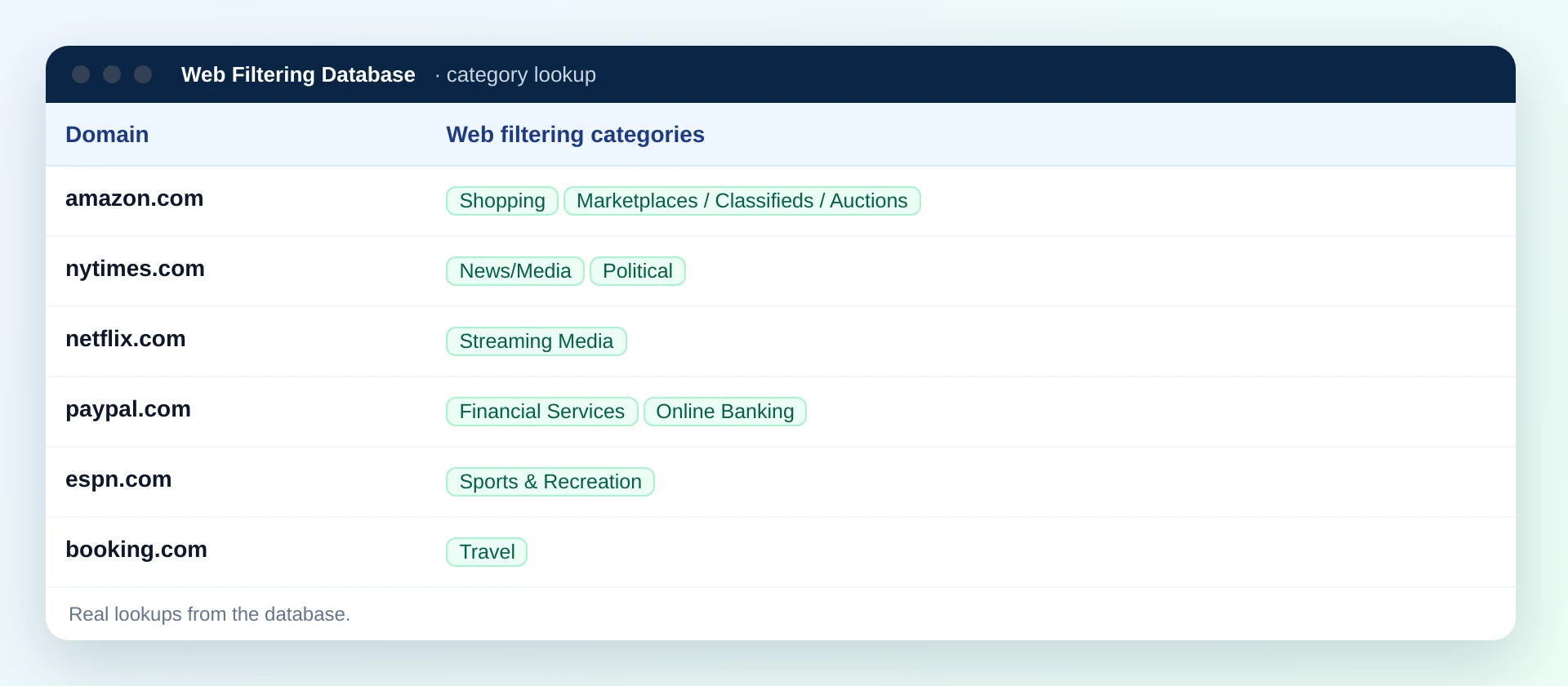
Five well-known domains and the categories stored for each
These rows come straight from our data. The first category in each row is the main one; the rest describe other parts of the same site.
| Domain | Categories in rank order | Count |
|---|---|---|
| kakao.com | Advertising/Marketing, Business, CDN / Hosting / Infrastructure, Cloud Storage / File Hosting, Email and Messaging, Social Networking, Streaming Media, URL Shorteners, Web-based Applications | 9 |
| yahoo.co.jp | Search Engines & Platforms, News/Media, Shopping | 3 |
| stackoverflow.com | Developer Tools / Code Hosting, Education/Reference, Forums / Message Boards | 3 |
| webex.com | Business, Web-based Applications, Webinars/E-learning | 3 |
| microsoft.com | Computers & Technology, Business, Web-based Applications | 3 |
The category pairs that appear most often
Counted across all domains with two or more categories. The last column is what each pair means for a filter rule.
| Pair | Domains | What it means for a rule |
|---|---|---|
| Food & Drink + Restaurants & Dining | 514,393 | Harmless together; matters only to analytics and reporting |
| Business + Home & Garden | 449,009 | Trades and suppliers; blocking either would hit real work |
| Business + Computers & Technology | 399,385 | Software vendors and IT services; never a blocking pair |
| Home & Garden + Shopping | 332,091 | Online shops; shopping blocks at work reach these |
| Automotive & Transportation + Business | 299,688 | Dealers, logistics and fleets |
| Business + Shopping | 293,325 | Business-to-business stores as well as retail |
| Arts & Entertainment + Blogs/Personal Sites | 227,058 | Creator sites; blog blocks are rarely wise |
| Advertising/Marketing + Business | 216,139 | Agencies as well as ad networks; ad blocking needs care |
| Gambling + Gaming | 184,402 | About 43% of gambling domains also carry Gaming; blocking Gaming is not a gambling policy |
| CDN / Hosting / Infrastructure + Parked / For-Sale Domains | 92,693 | Parking pages served by hosting companies |
What multi-category data means for a filter policy
Six lessons from the numbers, for anyone writing block rules or building them into a product.
Read every category for safety rules
A site that is 30% adult is still adult for a school or library. For the safety set, any matching category should block.
Use the main category for broad rules
Business, Shopping and Education appear on millions of sites as a secondary label. Blocking on any match there over-blocks badly.
Name gambling directly
Gaming and Gambling overlap on 184,402 domains. Block Gambling itself rather than hoping a gaming block catches betting.
Expect AI tools inside other sites
97.5% of AI-tool domains have another category, most often Business or Computers & Technology. An AI block always reaches sites people also use for ordinary work.
Report on the first category
For dashboards and monthly reports, counting a site once under its main purpose keeps totals readable and honest.
Keep an allow list above it all
No rule on categories will suit every site. A domain allow list fixes the odd case without loosening the rule for everyone.
Three ways a product can decide on a multi-category site
Most filters use one of these, or a mix: strict for the safety set, lenient for the rest.
Any category blocks
Block when any of the site's categories is switched off. Simple and strict.
Best for adult, weapons, VPN and other safety categories.Main category decides
Look only at the first category. Lenient, and close to how people describe a site.
Best for productivity rules and reporting.Weighted by rank
Block when a switched-off category is first or second, allow when it is further down.
A middle path for products with a "moderate" setting.How the licensed data supports strict, lenient and weighted decisions
Because every row keeps all of a site's categories in rank order, the same file serves an any-match rule, a main-category rule or a weighted one. Your product can switch between them per setting without a second data source.
The safety categories, one by one
The categories schools, libraries and family products block most often behave very differently. Some are almost always a site's only label; others usually sit next to a harmless one.
| Category | Domains | Also carry another category | Reading for a block rule |
|---|---|---|---|
| Adult | 222,358 | 30.2% | Mostly single-purpose sites; any-match blocking removes little else |
| Gambling | 425,075 | 53.6% | Often paired with Gaming or Sports; block the category itself |
| Weapons | 29,568 | 60.9% | Shops and hunting sites; Shopping and Sports often appear beside it |
| Illegal Drugs | 16,345 | 72.4% | Most often a shop, and often next to Health & Medicine; check before allowing health sites in bulk |
| Violence | 4,371 | 31.3% | Small and mostly self-contained |
| VPN / Proxy / Anonymizers | 10,988 | 47.7% | About half are pure bypass services; the rest also sit in technology, software or hosting categories |
| Hate/Discrimination | 1,217 | 79.0% | Most often next to Political, then Violence and Religion |
| Dating | 38,937 | 80.5% | Most often paired with Adult, then Community Sites |
| Alcohol | 154,272 | 70.5% | Breweries, wineries and shops; Food & Drink is the usual partner |
| Lingerie/Swimsuits/Intimate Apparel | 25,335 | 78.3% | Usually a Shopping site with one department in the category |
The last row is why family presets often leave Lingerie off by default: on most of those domains it describes one department of a general clothing shop.
Six questions to ask about any category data
Whether you license our data or someone else's, these answers decide how well your rules will behave on the 37.6%.
Does a domain keep several categories?
If the answer is one label per domain, a third of popular sites lose part of their description.
Are the categories ranked?
Without an order you cannot tell the main purpose from a side section, and lenient settings become guesswork.
Is there a fixed maximum?
Some domains genuinely have four or more roles. A hard cap silently drops the rest.
Domain level or page level?
Domain categories suit DNS and network filters. Page-level labels need a proxy or agent to use them.
How often are rows refreshed?
Sites add and drop sections. Categories that never change drift away from what the site is today.
Is the taxonomy the same everywhere?
One definition per category across the whole file is what makes any-match and main-category rules predictable.
What the numbers count
Read these figures with their scope in mind.
A one-label list next to ranked multi-category data
What changes for a product when the data keeps every category.
| Question your product faces | One label per domain | Ranked categories per domain |
|---|---|---|
| A betting site with sports news | Either Gambling or Sports, never both | Gambling first, Sports & Recreation second |
| A design app with AI features | Usually filed as an app; the AI side is invisible | Web-based Applications plus AI / LLM Tools |
| Strict and lenient settings | The same answer for both | Any-match for strict, main category for lenient |
| Monthly reports | One label, sometimes the wrong one | The main category for totals, the rest for detail |
| Sites with four or more roles | Reduced to one | All of them kept, in order |
Multi-category websites: frequently asked questions
How many websites belong to more than one category?
In our web filtering data for the 20 million most visited domains, 37.6% carry more than one category: 27.4% have two, 8.6% have three and 1.6% have four or more.
Which categories most often appear together?
The most common pair is Food & Drink with Restaurants & Dining, on about 514,000 domains. Business with Home & Garden and Business with Computers & Technology follow, and Gambling with Gaming appears on about 184,000 domains.
Do popular websites carry more categories?
Slightly. 40.3% of the 1 million most visited domains carry more than one category, against 37.0% of the domains ranked between 5 and 20 million.
Which categories are usually the only category on a site?
Parked / For-Sale Domains, Adult and Violence are the most self-contained: about 70% of the domains in each carry no other category.
Should a filter block a site if any of its categories is blocked?
For safety categories such as Adult, yes. For broad categories such as Business or Shopping, deciding on every category over-blocks; many products check all categories for the strict set and the main category for the rest.
What does the order of categories mean?
In our data the categories of a domain are ranked by how much of the site they describe, so the first one is the site's main purpose and the others are secondary.
The 1 million most popular domains start at $999 as a database licence, with larger tiers up to the full file, and OEM licences for products are quoted per deployment. Every tier carries the ranked categories shown on this page.
Build your rules on data that keeps every category
Tell us what your product decides and for whom. We will suggest the tier and the fields that fit, including ranked categories and IAB labels.