URL category data for web hosts, website builders and registrars
A hosting company or registrar can have millions of customer domains and almost no idea what most of them are. This guide is for trust and safety, abuse and compliance teams who need that picture: which customers run gambling, adult or weapons sites, which are parked, and which ones need a closer look.
Five things category data does for a host or registrar
Joining a customer domain list to categories takes minutes and serves several teams at once.
Acceptable use
Find the sites your policy restricts or reviews, without opening each one.
Payment risk
Flag business types your payment provider treats as higher risk.
Abuse triage
Put complaints about gambling or adult sites ahead of routine tickets.
Portfolio insight
See what kinds of sites you host, and how many names are simply parked.
Sign-up checks
Check the domain a new customer brings before the account goes live.
See what every customer domain is, without fetching a single page
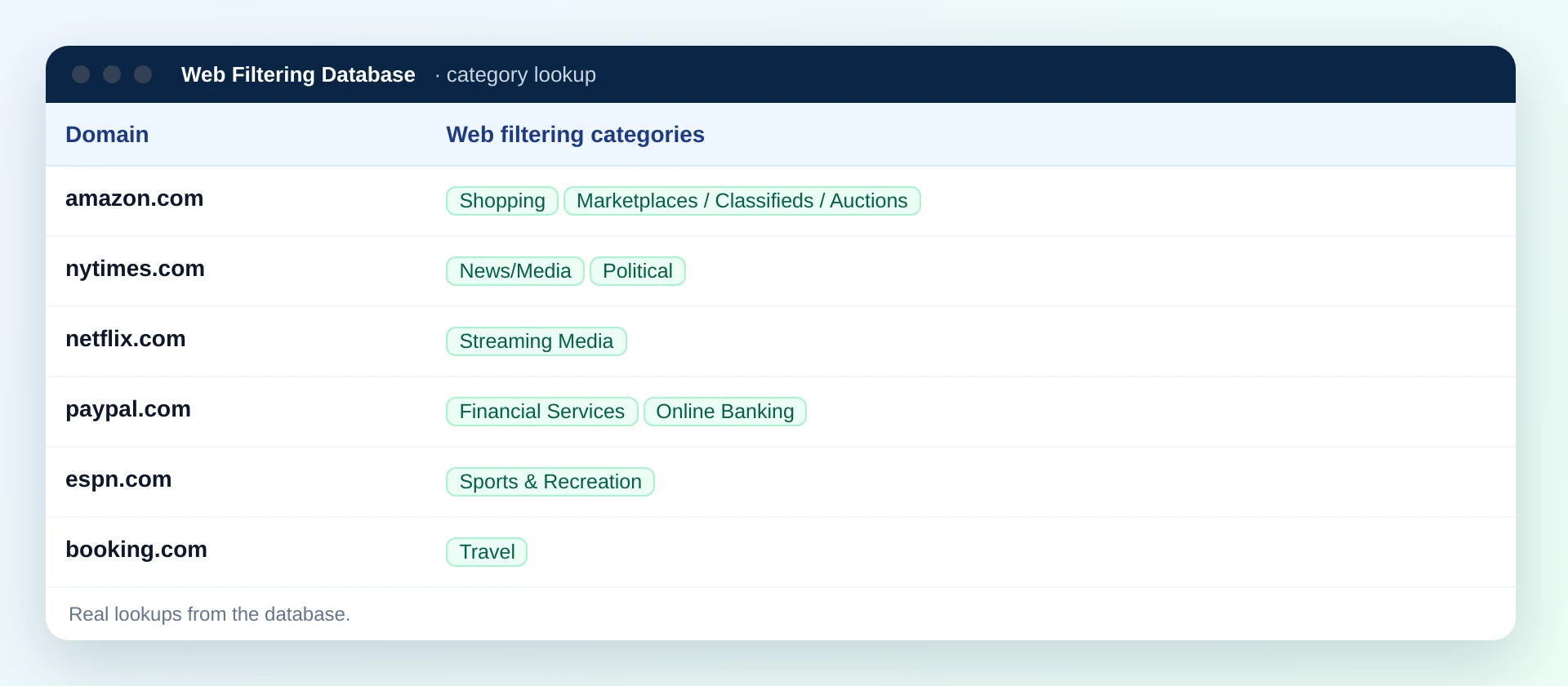
Load our database in your own systems and join it to your customer domains. Each domain gets its web filtering categories and IAB labels, so trust and safety, risk and product teams work from one picture, and no customer data leaves your company.
- Categories for customer domains across 120 million records.
- Refresh deliveries to catch sites that change purpose.
- New domains categorized every day, for recent sign-ups.
Mapping categories to your acceptable use policy
Every host's policy is different. A common starting point, with the action most teams take first:
| Category | Why it matters | First action |
|---|---|---|
| Gambling | Many jurisdictions require operator licences; some hosts ask for proof | Review and request licence details where your policy requires them |
| Adult | Allowed by some hosts with conditions; age checks are required by law in some places | Check against your policy and any age-verification rules that apply |
| Illegal Drugs | Often prohibited outright | Review; many sites in this category are legal shops for related goods |
| Weapons | Sales are regulated in many countries | Review against your policy and local law |
| Hate/Discrimination | Prohibited by most acceptable use policies | Priority review |
| VPN / Proxy / Anonymizers | Open proxies attract abuse complaints | Check for open proxy services |
| File Sharing/P2P | Copyright notices | Watch the complaint queue for these customers |
| Cryptocurrency | Payment risk and scam patterns | Route to the risk team |
| Parked / For-Sale Domains | Low content risk, little real use | Usually no action; useful for reporting |
A category is a reason to look, not a verdict. Keep a person in the loop before any account action, and record the reason for each decision.
Shared platforms and tenant sub-domains
Categories describe registrable domains. That matters for website builders and blog platforms, where many customers live under one shared domain.
Custom domains customers connect
- Each has its own row and categories
- Join them to the database like any other domain
- The main use of category data for builders
Sites on your shared domain
- customer.yourbuilder.example inherits your platform's category
- Needs your own content checks at the page level
- Category data still helps for links those sites point to
Five platform and marketplace domains and how they are classed
Real rows from our data. Platform domains carry the category of the platform as a whole, which is why tenant sites need their own checks.
| Domain | Categories in our data | What it shows |
|---|---|---|
| wixsite.com | Blogs/Personal Sites | Tenant sites share the platform's category |
| weebly.com | Blogs/Personal Sites | Same pattern for another site builder |
| godaddy.com | CDN / Hosting / Infrastructure, Parked / For-Sale Domains | A host and registrar with parking pages |
| sedo.com | Parked / For-Sale Domains | A domain marketplace |
| afternic.com | Parked / For-Sale Domains | Another domain marketplace |
A monthly review in five steps
Most teams run this as a scheduled job, with a short human review at the end.
Export
Pull the list of active customer domains and their account identifiers.
Join
Match each domain to the latest delivery of the database.
Compare
Diff this month's categories with last month's for the same domains.
Queue
Send domains entering restricted categories to the review queue.
Decide and record
A reviewer decides, with the reason stored against the account.
Step 3 is where the value is. A domain that moves from Blogs to Gambling between two deliveries is exactly what an acceptable use team needs to see.
Who uses it, and for what
Three kinds of company use domain categories in slightly different ways, often with the same file and the same monthly job.
Web hosts
- Acceptable use reviews by category
- Abuse ticket priority
- Payment risk flags for billing
Website builders
- Custom domains customers connect
- Links tenant sites point to
- Template and plan decisions by site type
Registrars and resellers
- What registered names actually host
- Share of parked and for-sale names
- Policy checks where a registry restricts content
How the database supports a monthly customer review
Scheduled refresh deliveries, from quarterly to daily depending on the plan, update the categories of existing domains, and about 300,000 newly registered domains are categorized every day. Comparing two deliveries for your customer list shows which sites changed purpose since the last review.
Privacy and customer trust
Customers are right to ask what a host does with their data. A domain lookup in your own systems is about the lightest check possible.
| Question a customer might ask | The answer with local category data |
|---|---|
| Do you read my site's content? | No. Only the domain name is looked up, in a file we hold |
| Is my information sent to anyone? | No. The database runs inside our systems; nothing leaves |
| Can I be suspended because of a category? | Not by the category alone; a person reviews first |
| What if my site is classed wrongly? | Our review checks the site itself before any decision |
Screening at sign-up
The moment a customer connects a domain is the cheapest moment to ask questions. Five checks that take no time at all with the data in place:
Its category
A domain already categorized as Gambling or Adult goes straight to the matching policy check.
Not yet categorized
Brand-new names have no row yet; recheck after a week, when new domains are looked at again.
Recently parked
A parked name turning into a live site is normal; a parked name moving to a restricted category is worth a look.
Licence evidence
For regulated categories, ask for the documents your policy requires before going live.
Billing route
Higher-risk categories may need a different payment check or plan.
Reporting on your portfolio
Once the join runs every month, a short portfolio report answers questions management and partners ask.
| Figure | What it tells you |
|---|---|
| Share of customer domains by category | What your platform is actually used for, compared with the web's own mix |
| Share parked or for sale | How many names carry no real site, useful for registrars and resellers |
| Domains in restricted categories | The size of the review workload, month by month |
| Domains that changed category | Where the next review should start |
| Share not yet categorized | How many customers are very new or very small |
For a baseline, our category shares of the 20 million most visited domains show how the wider web splits.
Six mistakes in category-based reviews
Each one either misses real problems or upsets good customers, and both cost more to fix later than to avoid now.
Acting on the category alone
A category starts a review; a person ends it. Automatic suspensions anger legitimate customers.
Checking only at sign-up
Sites change purpose. Review on every refresh, not once.
Ignoring secondary categories
A shop with Gambling as its second category still sells betting. Read the whole row.
Treating tenants like domains
Sub-domain tenants inherit the platform's category; check them another way.
No record of reasons
Without notes, the same site is reviewed again next month with no memory.
One policy for every country
Gambling, weapons and adult rules differ by jurisdiction; let the review reflect where the customer operates.
Reviewing customer sites by hand, or starting from category data
The same customer base, two ways.
| Task | Manual review | Licensed category data |
|---|---|---|
| Finding restricted sites | Wait for complaints or sample at random | Every customer domain joined to its categories |
| Sites that change purpose | Noticed only when reported | Diff between two deliveries |
| Customer privacy | Staff open customer sites | Only domain names are looked up, in your systems |
| New sign-ups | No information on day one | About 300,000 new domains categorized daily |
| Reporting to management | Anecdotes | Shares of your portfolio by category |
Category data for hosts and registrars: frequently asked questions
How can a web host know what its customers' sites are about?
Join the list of customer domains to a domain category database. Each domain gets its categories, so the trust and safety team can review gambling, adult or weapons sites against the acceptable use policy without opening every site.
Does category data scan our customers' content?
No. You look up domain names in a file that runs in your own systems; nothing about your customers or their sites is sent anywhere, and no content is fetched from your servers.
What about customer sites on our own sub-domains?
Categories describe registrable domains. Tenant sites on a shared platform domain inherit the platform's category, so they need your own content checks; custom domains that customers connect have their own rows.
Which categories matter most for acceptable use reviews?
Usually Gambling, Adult, Illegal Drugs, Weapons, Hate/Discrimination, VPN / Proxy / Anonymizers and File Sharing/P2P. Which ones you restrict depends on your policy and the laws where you operate.
Can category data help with payment risk?
Yes. Payment providers treat some business types as higher risk. Knowing which customers run gambling, adult or crypto sites lets billing and risk teams apply the right checks.
Can registrars use category data too?
Yes. Registrars and resellers join their registered names to the database to see what the names host, how many are parked or for sale, and which may conflict with a registry's content rules.
What happens with domains that are not yet categorized?
Very new domains may not have a row yet. About 300,000 newly registered domains are categorized every day, so recheck them after a few days, or use the included lookup API for single checks.
How often should customer domains be checked?
At sign-up and then with every refresh delivery of the database. Sites change purpose, so a domain that was a blog last year can be a betting site today.
This guide gives general information. Rules for gambling, adult content, weapons and other regulated activities differ between countries; check your own obligations with qualified advisers.
Database licences start at $999 for the 1 million most popular domains and scale to the full 120 million; licences for use across a hosting or registrar business are quoted per deployment. Tell us how many customer domains you manage and how often you review them.
Know what you host before someone else tells you
Tell us about your customer base and your review process. We will propose the tier, the refresh schedule and the licence for your trust and safety work.
Domain names in the tables identify platforms for illustration only. Web Filtering Database is not affiliated with, sponsored or endorsed by their owners.